
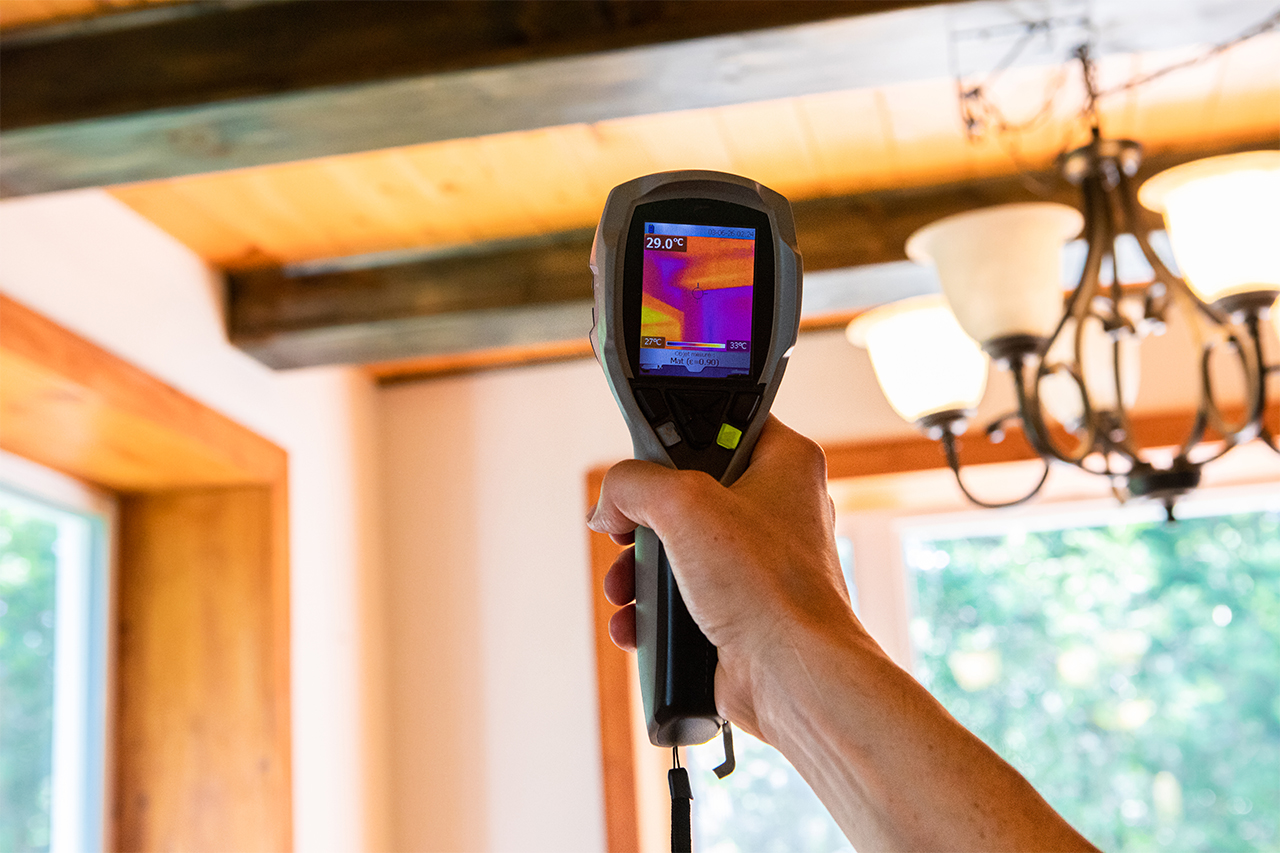
Indoor air quality has become a bigger concern for homeowners and business owners who want to better understand what they are breathing every day. With consumer air-quality monitors now widely available, it is easier than ever to place a device in a room and begin tracking certain conditions such as airborne particles, temperature, humidity, carbon dioxide, or volatile organic compounds.
These devices can be useful, but they are not the same as a professional indoor air evaluation. A monitor can provide data about certain conditions in a room, while a professional assessment looks at the broader picture, including moisture, building conditions, ventilation, odors, previous water damage, potential mold concerns, and other environmental factors. Understanding the difference can help property owners decide when a DIY monitor may be helpful and when it may be time to bring in a professional.
What Is a DIY Indoor Air Quality Monitor?
A consumer indoor air quality monitor is typically a small electronic device designed to measure one or more environmental conditions inside a home or business. Depending on the model, a monitor may track particulate matter, carbon dioxide, temperature, relative humidity, and estimated levels of volatile organic compounds. Some devices also provide an overall air-quality score through a mobile app.
The biggest advantage of these monitors is that they can collect information continuously. Instead of checking conditions once, they can show how readings change throughout the day. For example, you may notice that particulate readings rise while cooking, humidity increases after showers, or carbon dioxide levels rise when several people occupy the same room with the windows closed. That information can be useful for identifying patterns.
What DIY Air Monitors Can Tell You
Consumer air monitors can help homeowners develop a better understanding of everyday indoor conditions. A humidity sensor, for example, can help show whether a basement is consistently more humid than the rest of the home. A particle monitor may show when airborne particle levels increase during cleaning, cooking, renovation work, or other activities.
Carbon dioxide readings may also provide information about how occupied or poorly ventilated a room becomes over time. If the air-quality monitor repeatedly shows higher readings at certain times or in specific rooms, that pattern may provide useful information about what should be investigated further. These readings can help you notice changes that might otherwise go unnoticed.
The Limitations of Consumer Air Quality Monitors
The most important thing to understand is that a consumer monitor generally measures specific conditions. It does not necessarily tell you what is causing those conditions. For example, a particle monitor may indicate that airborne particle levels have increased, but it may not be able to tell you whether those particles are dust, pollen, pet dander, renovation debris, smoke, or another source. Similarly, a humidity monitor can tell you that moisture levels are elevated, but it cannot necessarily determine whether the cause is a plumbing leak, foundation seepage, poor ventilation, condensation, or another source.
Many consumer monitors also use different types of sensors, and the accuracy and sensitivity of those sensors can vary from one device to another. This means that the number shown on the screen should usually be treated as one piece of information rather than a complete diagnosis of the indoor environment.
Can a DIY Monitor Detect Mold?
This is where many homeowners become confused. Most general-purpose indoor air quality monitors do not directly identify whether mold is present inside a home. A monitor may detect conditions associated with a greater risk of moisture problems, such as elevated humidity, but it generally cannot tell you whether mold is growing behind drywall, beneath flooring, inside a basement wall, or around a hidden plumbing leak.
Mold evaluation usually requires understanding the building, moisture history, visible conditions, odors, affected materials, and sometimes appropriate sampling or testing depending on the situation. A consumer monitor can therefore provide clues, but it should not be treated as proof that mold is or is not present.
Why Professional Evaluation Provides More Context
Professional indoor air evaluation goes beyond looking at a single reading. A trained professional can evaluate the property itself and consider how the building is functioning. This may include looking for moisture staining, condensation, leaks, ventilation problems, basement seepage, damaged materials, previous flooding, unusual odors, and other conditions that may contribute to indoor air concerns.
The advantage is context. A monitor might show that humidity is consistently high in a basement. A professional evaluation can help investigate why. A monitor might show elevated particle readings. A professional can consider whether renovation dust, HVAC airflow, filtration, moisture, or another environmental condition may be contributing. That broader evaluation can help property owners make better decisions about what should happen next.
Professional Testing Can Help Identify the Source
When homeowners have an indoor air concern, the most important question is often not simply, “What number is on the monitor?” The more useful question is, “What is causing this?” A musty odor could be associated with moisture behind a wall. High humidity could be related to poor ventilation or basement seepage. Dust may be coming from renovation work, an HVAC system, exterior air, or another source.
Professional evaluation can help connect the symptoms to the building conditions. That information matters because the correct solution depends on the source. An air purifier may help with certain airborne particles, but it will not repair a plumbing leak. A dehumidifier may help reduce humidity, but it will not fix foundation seepage. Increasing ventilation may help with stale air, but it will not remove damaged building materials. Understanding the cause helps prevent homeowners from spending money on a solution that does not address the actual problem.
DIY Monitors Are Excellent for Tracking Patterns
This does not mean consumer air monitors are useless. In fact, they can be very helpful when used for the right purpose. A monitor can help establish a baseline for your home. Over time, you can see what is normal and recognize when conditions change.
You may notice that humidity increases after heavy rain. You may see particle levels rise while cooking. Carbon dioxide levels may climb in a bedroom overnight. Air-quality readings may improve after opening windows or changing HVAC settings. Those patterns can provide useful information when discussing a concern with an indoor air professional. Instead of simply saying that a room “feels stuffy,” you may be able to explain when the condition happens and how the readings change.
When a Professional Evaluation May Be Worth Considering
A DIY monitor becomes less useful when the problem requires an explanation rather than simply a measurement. For example, professional evaluation may be appropriate when there is a persistent musty odor, repeated basement moisture, visible discoloration, water damage, suspected mold, recurring condensation, a roof leak, plumbing leak, or unexplained indoor air concern.
The same is true when a consumer monitor repeatedly shows unusual readings and you cannot determine why. If the monitor is consistently showing high humidity in one room, the next step may be figuring out where the moisture is coming from. If airborne particle readings remain elevated despite cleaning and filter changes, the source may need closer investigation. Professional evaluation can provide the additional context needed to move from observation to action.
After Water Damage, Professional Evaluation Can Be Especially Valuable
Water damage is one of the situations where a basic air monitor may not provide enough information. Water can travel behind walls, under flooring, into insulation, and through other building materials. A humidity sensor in the room may eventually return to a normal reading even while moisture remains trapped in concealed areas. This is why water-damaged properties often need more than general air monitoring.
A professional evaluation may include a closer look at building materials, moisture history, visible staining, odors, and other indicators that suggest additional investigation is needed. This can be particularly important after basement flooding, roof leaks, burst pipes, appliance leaks, or long-term foundation seepage.
What About VOC Monitors?
Some consumer devices estimate volatile organic compound levels. VOCs can come from many sources, including paints, cleaning products, adhesives, fragrances, new furniture, flooring, and other household materials.
A VOC reading may show that something in the environment has changed, but consumer sensors often provide a general estimate rather than identifying the exact chemical or source. If the readings rise after painting or using a cleaning product, the pattern may be relatively easy to understand. If readings remain elevated without an obvious cause, professional evaluation may provide more useful context. Again, the reading is most valuable when it helps guide investigation rather than being treated as a complete answer.
Ventilation Is Another Area Where Context Matters
Many people purchase air-quality monitors because a room feels stale or stuffy. Some devices can track carbon dioxide, which may help indicate that a heavily occupied room is not receiving enough fresh-air exchange. That information can be useful, especially in bedrooms, offices, classrooms, or commercial environments where occupancy changes throughout the day. However, ventilation problems can involve more than one factor.
Blocked return vents, closed dampers, HVAC performance, building design, exhaust systems, room layout, and occupancy can all affect airflow and comfort. A professional evaluation can help look at the larger picture rather than focusing on one number.
Professional Testing and Air Purification Should Work Together
One of the biggest mistakes homeowners can make is purchasing an air purifier before understanding the problem they are trying to solve. Air purification can be a valuable part of an indoor air-quality strategy, but the right solution depends on the concern.
If the primary problem is excess moisture, the moisture source should be addressed. If the issue is mold growth in damaged building materials, remediation may be needed. If the problem involves ventilation, airflow improvements may be more important. If airborne particles are the primary concern, purification may play a larger role. Professional evaluation can help determine where air purification fits into the overall solution rather than treating it as a universal fix.
The Best Approach May Use Both
For many homeowners, the best approach is not choosing between a consumer monitor and professional evaluation. It is using each for what it does best. A DIY monitor can help you track everyday conditions and recognize patterns.
Professional evaluation can help explain those patterns, investigate the property, identify potential sources, and determine what type of solution may be appropriate. Together, they can provide a much clearer picture of the indoor environment. The monitor tells you that something changed. The evaluation helps determine why.
Stop Guessing and Start With Better Information
Indoor air quality problems are often difficult to understand because many of the most important conditions are not immediately visible. Moisture can exist behind walls. Odors can originate in hidden areas. Airborne particles may have several possible sources. A room can look perfectly clean while still having ventilation or moisture concerns. Consumer air-quality monitors can provide useful information, but they are only one tool. When there are persistent concerns, professional evaluation can provide the context needed to understand what may be happening and determine the right next step.
Professional Indoor Air Quality Testing in Wisconsin
Elite Indoor Air LLC provides professional indoor air quality testing, air analysis, environmental consulting, mold detection and testing, mold remediation, odor solutions, asbestos inspection, air cleaning, and air purification options for residential and commercial properties.
If your air-quality monitor is showing unusual readings, or if you are dealing with moisture, odors, suspected mold, water damage, or other indoor air concerns, professional evaluation can help you move from guessing to better information.